

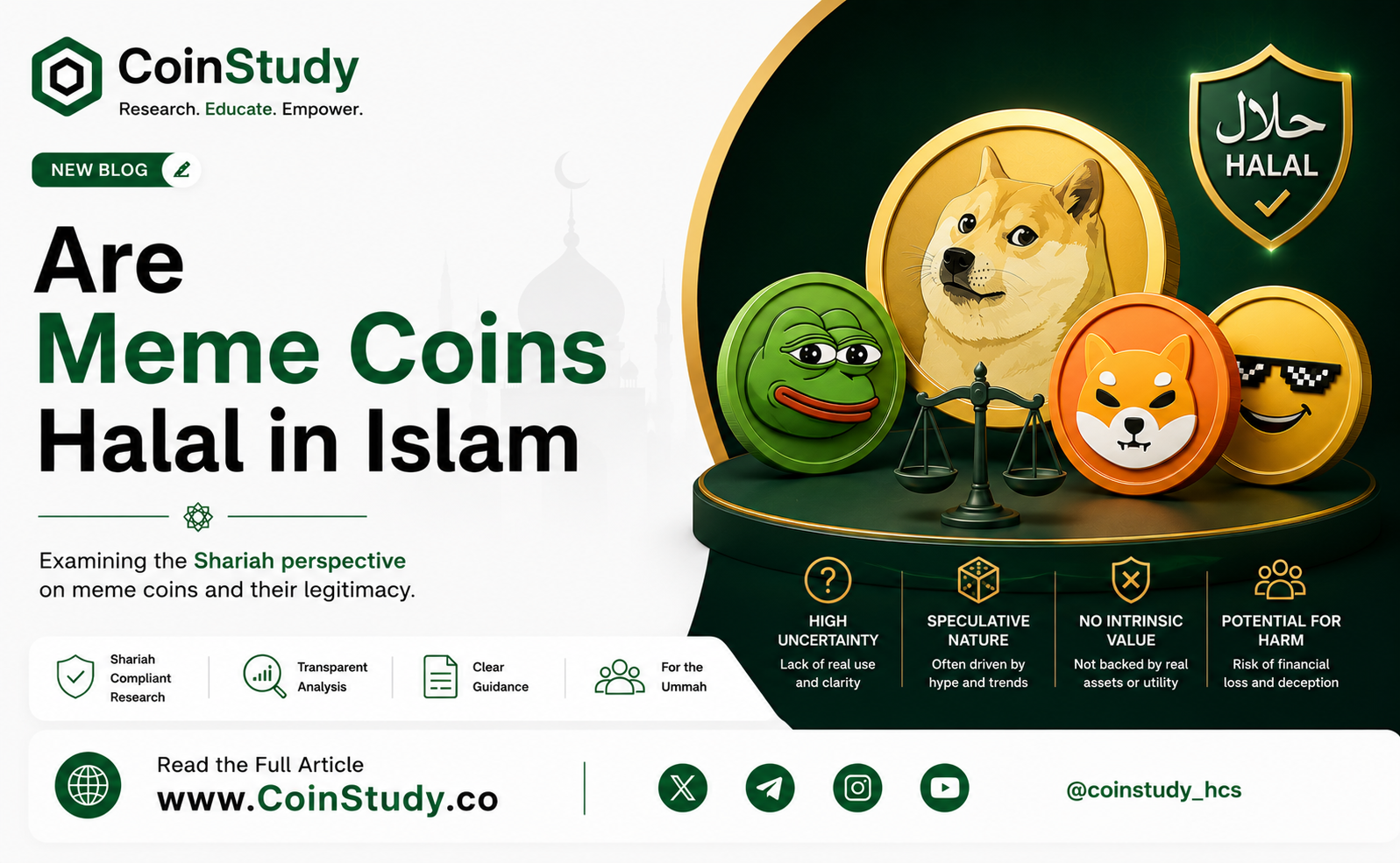
Are Meme Coins Halal or Haram? A Complete Islamic Finance Analysis
Every crypto bull market produces the same story.
Someone turns $500 into $500,000 on a meme coin. Screenshots circulate across Telegram groups, Twitter threads, and WhatsApp messages. The story goes viral across Muslim investing communities. Questions flood our inbox at CoinStudy. People want to know if this is permissible. If they have missed something halal. If Islamic finance allows participation in what everyone around them seems to be profiting from.
The honest answer requires understanding three things simultaneously: what meme coins actually are at a structural level, what Islamic finance principles say about that structure, and what the documented evidence about meme coin market outcomes shows about who actually profits and who actually loses.
The 2026 data is now comprehensive enough to answer all three questions with specificity rather than generality. Binance Research finds approximately 97% of meme coins die or lose meaningful trading volume, with an average lifespan near one year. Chainalysis tracked over $2.8 billion in rug-pull losses across the meme coin category in 2025 alone. Pump fun's graduation rate fell to 0.26% by June 2026, meaning most launched tokens never even reach a decentralized exchange listing before dying. (arXiv + 2)
These are not opinions about meme coins. They are documented outcomes from the world's most widely used meme coin infrastructure. Understanding them is essential for any Muslim investor who wants to engage with this question honestly.
Quick Verdict: Most Meme Coins Are Doubtful to Haram ⚠️
Most meme coins fail to achieve Halal classification under the CoinStudy Halal Crypto Standard due to fundamental Maysir concerns from speculative market dynamics where early participants profit from later participants' losses, structural Gharar from value drivers rooted entirely in social media hype rather than economic fundamentals, minimal or nonexistent genuine utility, and documented pump and dump structures that transfer wealth from uninformed later buyers to informed early holders.
Some meme coins land in the Doubtful category, passing the red-line screening on technical grounds but scoring poorly on the seven weighted HCS dimensions. Others approach or reach the Haram boundary. Very few achieve Halal classification and those that do share specific characteristics that distinguish them from pure meme tokens. Our Shariah Board Chairman Dr. Usman Quddus has confirmed this framework directly in his ruling on Dogecoin, establishing that when speculative uncertainty becomes permanent and genuine demand never develops, avoidance becomes necessary.
What Meme Coins Actually Are — The Structural Reality
Meme coins are cryptocurrencies created around internet culture, viral trends, online communities, and social media momentum rather than genuine technological innovation, utility, or productive economic purpose.
Their value is driven almost entirely by community hype, influencer promotion, viral content spread, and speculative trading cycles. Most were created without serious technical purpose. Many were launched anonymously. Most have no whitepaper, no development roadmap, no service being provided to any user who genuinely needs it, and no measurable economic activity they enable.
The price of a meme coin goes up when enough people believe it will go up and buy it. It goes down when the buying stops and early holders sell. There is rarely any fundamental reason for either movement. No revenue is being generated. No adoption metric is improving. No technology is being deployed for genuine use. The price movement exists because of the movement itself.
This is not an exaggeration or an oversimplification. It is the honest structural description of how the overwhelming majority of meme coin price cycles work. Understanding this structure is the prerequisite for understanding why Islamic finance reaches the conclusions it does about them.
The 2026 Evidence — What the Data Actually Shows
The Islamic finance assessment of meme coins is strengthened significantly in 2026 because we now have comprehensive documented evidence rather than theoretical concerns about what might happen.
The meme coin category market cap sits near $30.6 billion as of June 2026, with Dogecoin alone at approximately $14.28 billion. This scale gives us enormous datasets of actual outcomes rather than projections. arXiv
Chainalysis analysis found 74,037 tokens launched in 2024 were suspected of being linked to pump-and-dump schemes, equaling approximately 3.59% of all tokens launched that year. arXiv
Research documenting meme coin market manipulations found that 62.9% of tokens subjected to profit extraction operations had previously undergone wash trading or liquidity pool inflation, revealing how initial manipulations often serve as preliminary stages in broader exploitation strategies. Better Markets
Among meme coins delisted by established aggregators, 86.67% of those subjected to profit extraction had previously been artificially inflated, as token creators first use artificial growth tactics to meet listing requirements and then leverage their newfound visibility to execute exit strategies. Better Markets
On Pump.fun specifically, which is the world's dominant meme coin launchpad with over six million tokens created, CoinStudy's analysis documented that users collectively lost $4 to $5.5 billion while the platform earned $935.6 million. The platform's 98.6% scam rate per Solidus Labs research represents the most comprehensive documented evidence of systematic wealth transfer from retail participants to early insiders in any financial product category.
Extreme volatility is the hallmark of meme coins. Price swings of tens of percent in minutes, 100x run-ups in hours, and near-total losses in a day are commonplace.
These statistics are not abstract regulatory concerns. They represent real people who transferred real wealth into a financial product category whose documented structure produces systematic losses for the majority of participants while generating gains for a small number of early and informed insiders.
The SEC Regulatory Position — What It Does and Does Not Mean
The SEC's Division of Corporation Finance said in 2025 that meme coins are generally not considered securities, stating that meme coins typically do not generate a yield or provide a claim to future income, profits, or business assets. Kba
Some Muslim investors interpret this regulatory classification as validation that meme coins are permissible financial instruments. This interpretation misunderstands what the SEC's statement actually means and does not mean.
The SEC's determination that meme coins are not securities means they fall outside the specific regulatory jurisdiction of US securities law. It does not mean they are safe investments. It does not mean their market dynamics are fair or transparent. The SEC takes the view that meme coins are not securities but collectibles, meaning they are excluded from coverage under the federal securities laws. This exclusion from regulatory protection makes meme coin investors more vulnerable to manipulation, not less.
Class action lawsuits are pending in US federal courts alleging that pump and dump schemes are inherent to Pump.fun's operations. Solidus Labs
The SEC's regulatory classification is about jurisdiction and legal oversight. Islamic finance's assessment is about the economic structure and its compliance with Sharia principles. These are entirely separate questions that happen to produce aligned conclusions for the opposite reason from what meme coin advocates sometimes suggest: the SEC's exclusion of meme coins from investor protection frameworks confirms rather than contradicts the Islamic finance concern about their speculative and manipulative character.
The Chairman's Ruling — Applied to Meme Coins
Our Shariah Board Chairman Dr. Usman Quddus provided a direct ruling in the context of Dogecoin that establishes the complete Islamic framework for evaluating all meme coins.
His ruling states: Most coins in the crypto market are used not as a genuine medium of exchange but primarily for their fame and temporary price fluctuations with the purpose of gaining profit. From this aspect, uncertainty is created in these coins which produces a resemblance to Maysir, generating a ruling of caution. If this uncertainty becomes permanent, avoidance will become necessary. The compliance status depends on supply matching genuine demand.
This ruling provides a two-path framework. If a meme coin develops genuine adoption as a medium of exchange where supply meets real transactional demand, the Maysir resemblance diminishes and the compliance concern reduces. If speculative use remains the dominant driver permanently and genuine utility never materializes at meaningful scale, avoidance becomes necessary rather than merely cautioned.
Applying this framework to the meme coin category in 2026 requires honest assessment of which path the category is on. The documented 97% death rate, the $2.8 billion in rug-pull losses, the 0.26% graduation rate on Pump.fun, and the systematic pump and dump operations affecting 62.9% of analyzed tokens all confirm that the overwhelming majority of meme coins are on the second path. Speculative uncertainty has become or is rapidly becoming permanent for the vast majority of meme coins launched each cycle.
Islamic Finance Analysis — The Three Core Principles
Riba — Not the Primary Concern
Most meme coin tokens themselves do not involve interest-based lending or borrowing mechanisms at the protocol level. A basic Dogecoin or PEPE token held in a wallet does not generate or require interest payments.
The Riba concern enters the meme coin analysis in two specific ways. First, when Muslim investors use margin or leverage to trade meme coins they are borrowing capital at interest to amplify speculation on an already-problematic asset. This compounds the compliance problem. Second, when meme coins are deposited into DeFi lending protocols to earn yield from borrowers, the lending income constitutes Riba regardless of the underlying token. But the meme coin token itself typically passes the Riba red line at the protocol level.
Gharar — Fundamental and Structural
Gharar refers to excessive uncertainty, specifically uncertainty about the fundamental nature, value, and economic purpose of what is being transacted. Islamic finance does not prohibit all uncertainty. It prohibits situations where the value of an asset has no stable foundation and the transaction depends entirely on factors that cannot be meaningfully analyzed.
Most meme coin valuations have no measurable fundamental foundation. Because their prices are driven by hype and sentiment rather than fundamentals like adoption or revenue, a coin's value can fall just as quickly as it rose, often with little warning. Charles Schwab
The price of PEPE is not related to any revenue, adoption metric, technology deployment, or service being consumed. It is related to whether enough people on social media remain excited about a cartoon frog. The uncertainty about that is not normal investment uncertainty around whether a business will succeed or fail. It is fundamental uncertainty about whether a hype cycle with no underlying substance will continue long enough for you to exit profitably before the people who arrived before you exit first.
When you cannot identify any economic reason for an asset to have value beyond the continuation of speculative interest among successive waves of buyers, that is the kind of foundational Gharar that Islamic finance's prohibition is specifically designed to address.
Maysir — The Most Direct and Serious Concern
This is where the analysis is clearest, most direct, and most supported by 2026 documented evidence.
Most meme coin market activity is driven by participants buying not because they believe the token creates genuine economic value, but because they believe other people will buy after them, driving the price up, creating an opportunity to sell at a profit to the next wave of buyers.
Pump.fun's design, in particular its bonding curve automated pricing, means early buyers of a new token see the price rise rapidly as more people buy in, creating strong incentives for insiders or influencers to aggressively promote a new coin, drive up its price, then secretly sell their holdings at the peak, leaving latecomers with heavy losses.
This is the specific financial structure that Islamic finance identifies as Maysir. Participants stake financial resources on uncertain outcomes where one party's gain is structurally and necessarily another party's loss with no productive economic activity occurring in between. The documented evidence from 2026 confirms this structure at enormous scale: $2.8 billion in documented rug-pull losses, 74,037 suspected pump and dump tokens from one year's launches, and a platform that earned $935 million while its users collectively lost $4 to $5.5 billion.
Every dollar that an early holder or insider profits from a meme coin pump and dump came from a later buyer's account. No economic value was created. Money transferred from one group of participants to another through a mechanism that the later buyers did not understand and could not effectively resist given the information asymmetry between insiders and retail participants.
The Pump and Dump — The Mechanism Every Muslim Investor Must Understand
In pump and dump schemes, influencers or insiders talk up a new coin in online groups or use celebrity endorsements to drive up the price. They then flood the market by selling their holdings, leaving later buyers holding a near-worthless asset. Charles Schwab
This is not a rare edge case in meme coin markets. It is a routine feature of the category that operates at industrial scale. The specific sequence is documented and consistent.
First, insiders and early buyers accumulate a token at very low prices before any promotion begins. Second, coordinated promotion across social media, Telegram groups, and influencer channels creates buying pressure from retail participants who see the price rising and feel urgency. Third, early holders sell their accumulated positions into the buying pressure created by promotional activity. Fourth, retail buyers who purchased during the promotional phase are left holding tokens that decline sharply once selling pressure from early holders exceeds buying pressure from new retail participants.
Research found that 86.67% of meme coins delisted by established aggregators that were subjected to profit extraction had previously been artificially inflated, revealing a coordinated effort to maximize gains before disappearing from the ecosystem. Better Markets
From Islamic ethics, not just Islamic finance compliance, participating in or enabling the promotion of tokens in ways that exploit uninformed retail buyers conflicts directly with the Islamic emphasis on honest commerce, protection of others from harm, and the prohibition on earning wealth through deception or exploitation of information asymmetry.
The Official Trump Token — A 2026 Case Study in Why Chairman's Framework Matters
The Official Trump meme coin launched in January 2026 days before the US presidential inauguration and provides the most documented recent example of how the Chairman's framework applies to specific meme coin events.
Approximately 80% of the total supply was controlled by entities affiliated with the Trump organization at launch. The token surged dramatically on celebrity and political momentum. Retail investors purchased at high prices based on the promotional narrative. The insiders' 80% supply position meant that any price appreciation primarily benefited entities that held enormous quantities acquired before public trading began.
The subsequent price decline from its launch peak illustrates the chairman's framework directly. Temporary fame drove the price. Supply did not meet genuine demand from users who needed the token for a productive purpose. The uncertainty has not resolved in favor of genuine utility. It has become permanent speculation on a politically-branded meme.
Our analysis of the Official Trump token at 52 out of 100 Doubtful reflects this accurately. The insiders' structural advantage, the absence of genuine utility development, and the chairman's confirmed framework about speculative uncertainty requiring caution all point to the same conclusion.
The Compliance Spectrum — Not All Meme Coins Are Identical
CoinStudy's individual analyses of major meme coins reveal a spectrum worth understanding because it demonstrates what factors actually matter in distinguishing better from worse compliance profiles.
Dogecoin scores 67 out of 100 Halal With Concerns, the highest score in the meme coin category. Over twelve years of continuous operation without collapse. Genuine merchant acceptance through AEON Pay's 50 million merchant network and Alchemy Pay's 173-country fiat onramp. SEC digital commodity classification in March 2026. TDOG ETF on Nasdaq. These are real characteristics that reduce some Gharar and establish genuine utility foundation that most meme coins simply do not have. However the chairman's conditional ruling, where avoidance becomes necessary if speculative uncertainty becomes permanent, applies to Dogecoin as well. In 2026, speculation still overwhelmingly dominates genuine transactional use.
Shiba Inu scores 59 out of 100 Doubtful, near the Haram boundary. Shibarium and ShibaSwap represent genuine ecosystem development attempts. But the ecosystem has not achieved meaningful adoption and speculative dynamics dominate market activity.
PEPE scores 54 out of 100 Doubtful and Bonk scores 55 out of 100 Doubtful. Minimal utility development. Extreme speculative dynamics. Community enthusiasm masking almost no fundamental economic value behind either token.
Official Trump scores 52 out of 100 Doubtful. Politically branded with insider supply concentration concerns and permanent speculative uncertainty.
The pattern is clear and consistent. Meme coin scores correlate directly with whether any genuine utility has developed beyond meme identity, how long the project has survived to demonstrate sustained existence, and how equitably the supply was distributed in the initial launch. Most meme coins fail on all three.
The FOMO Mechanism — Why It Is Specifically Problematic in Islamic Finance
Understanding meme coins requires understanding how their price cycles actually work because the mechanism itself reveals the compliance problem with precision.
A meme coin gets promoted by influencers, Telegram groups, X communities, and celebrities. Early holders promote aggressively because their tokens appreciate when new buyers arrive. New buyers see the price rising and feel urgency. Fear of missing out drives them to buy before the price goes higher. More buying drives more price appreciation which attracts more buyers.
At some point the buying slows. Early holders and insiders sell. The price falls. Late buyers are left with losses.
Every Muslim investor who buys a meme coin during an active hype cycle is almost certainly playing the role of the late buyer in this cycle, which is the person whose purchased capital funds the profits of whoever promoted and accumulated the token early. This is not a matter of bad luck or bad timing. It is the structural position of retail participants in a mechanism designed to extract value from them.
The Prophet Muhammad, peace be upon him, advised leaving that which makes you doubt for that which does not make you doubt. The meme coin market is built almost entirely on the things that should create doubt. The question is whether Muslim investors are honest with themselves about that.
What Actually Separates Better Meme Coins From Worse Ones
For Muslim investors who want to assess specific meme coins rather than the category as a whole, CoinStudy's analyses identify specific factors that differentiate compliance profiles within the Doubtful and Halal With Concerns range.
Operational history matters significantly. Dogecoin's twelve-year survival through multiple bear markets demonstrates something that a token launched last week cannot demonstrate: sustained existence without collapsing to zero, which reduces some Gharar concerns even when price dynamics remain speculative.
Genuine utility development matters. Shiba Inu building Shibarium, while not achieving meaningful adoption, represents an attempt to create genuine value that pure meme tokens do not even attempt. The attempt itself signals something different about the project's intent even if the outcome has not yet materialized at meaningful scale.
Token distribution fairness matters. Bonk's community airdrop with no venture capital allocation represents genuinely more equitable initial distribution than most meme tokens, including many that present themselves as community-focused while allocating large supplies to insiders. Fair initial distribution reduces the structural advantage of early insiders over retail participants.
Team accountability matters. Anonymous founding reduces governance transparency significantly. Projects with identifiable, accountable development teams carry less Gharar from the governance dimension than those built by anonymous creators who can disappear without consequence.
None of these factors make a meme coin clearly halal. They differentiate Doubtful from Haram-approaching, which are meaningful distinctions, but they do not overcome the fundamental Maysir and Gharar concerns that apply to the category broadly.
The Honest Self-Assessment Every Muslim Investor Needs
Before investing in any meme coin, answer this question with complete and unvarnished honesty.
Why am I buying this?
If the answer is that you genuinely believe this specific token provides real economic value that justifies its price based on identifiable utility development and genuine demand, that is investment thinking. Proceed carefully with individual research.
If the answer is that the price has been going up and you do not want to miss out, that is FOMO. Stop.
If the answer is that an influencer promoted it and it might pump, that is chasing promotional hype. Stop.
If the answer is that you think you can time the cycle and sell before it crashes, that is gambling thinking. Stop.
If the answer is that someone in your social network made money on a meme coin and you want to participate in the next opportunity, understand that the person who made money almost certainly did so as an early holder. The story you heard about their gains is itself part of the promotional mechanism that draws later buyers in to fund those early gains.
The chairman's framework is the most honest and useful guide here. Ask yourself: is this coin developing genuine demand where supply meets real transactional need? Or is the uncertainty about its purpose becoming permanent? The documented 97% death rate across the meme coin category suggests the answer for the vast majority of specific tokens is the latter.
Final Verdict
Most meme coins are classified as Doubtful or approach the Haram boundary under the CoinStudy Halal Crypto Standard and Muslim investors should treat the category with corresponding and sustained caution.
The statistics are stark: approximately 97% of meme coins die or lose meaningful trading volume, the average lifespan sits near one year, and $2.8 billion in rug-pull losses were tracked in 2025 alone. These are not projections about what might happen. They are documented outcomes of what has already happened to the vast majority of meme coin participants. arXiv
Most meme coins pass the red-line screening on technical grounds because the tokens themselves do not directly lend money at interest or operate betting platforms. But they score poorly on almost every dimension that matters after that: Gharar from hype-driven value with no economic foundation, Maysir from wealth transfer mechanisms between early insiders and late retail buyers, minimal Underlying Business Activity, and negligible genuine utility.
The exceptional cases, with Dogecoin as the clearest example, have operational history, developing genuine utility through merchant integrations, and regulatory classification that separate them from pure meme tokens. Even these score in Halal With Concerns territory rather than clean Halal ratings and carry the chairman's conditional caution: if speculative uncertainty becomes permanent, avoidance becomes necessary.
For Muslim investors, the chairman's framework applies with precision to this entire category. When something makes you doubt, and the 97% documented failure rate, the $2.8 billion in documented losses, the 74,037 suspected pump and dump tokens from one year's launches, and the 0.26% graduation rate should all make you doubt, the Islamic guidance is clear. Leave what makes you doubt for what does not make you doubt. The crypto market contains genuinely halal options with clear utility and transparent economic value. Start there.
Read detail analysis of following coins and concepts here:
Is Dogecoin Halal?
Is Pump fun Halal?
Is Shiba Inu Halal?
Is Official Trump Halal?
Is Crypto Trading Halal?
Disclaimer: This analysis is provided for educational and research purposes only and incorporates our Shariah Board Chairman Dr. Usman Quddus's direct ruling on meme coin speculation frameworks. CoinStudy does not issue personal fatwas or financial advice. Please consult a qualified Islamic scholar for individual guidance.